

Every funded startup reaches the same inflection point: should you hire a full-time marketing team or work with a fractional marketing consultant? The answer isn’t one-size-fits-all. Your funding stage, revenue trajectory, and strategic priorities determine which model delivers the best ROI. At GrowthExpertz, we help startups navigate this exact decision based on their growth stage and budget. Understanding when to leverage outsourced marketing services versus building an in-house team can mean the difference between efficient growth and burned capital.
The Real Cost Comparison: Beyond Salary Numbers
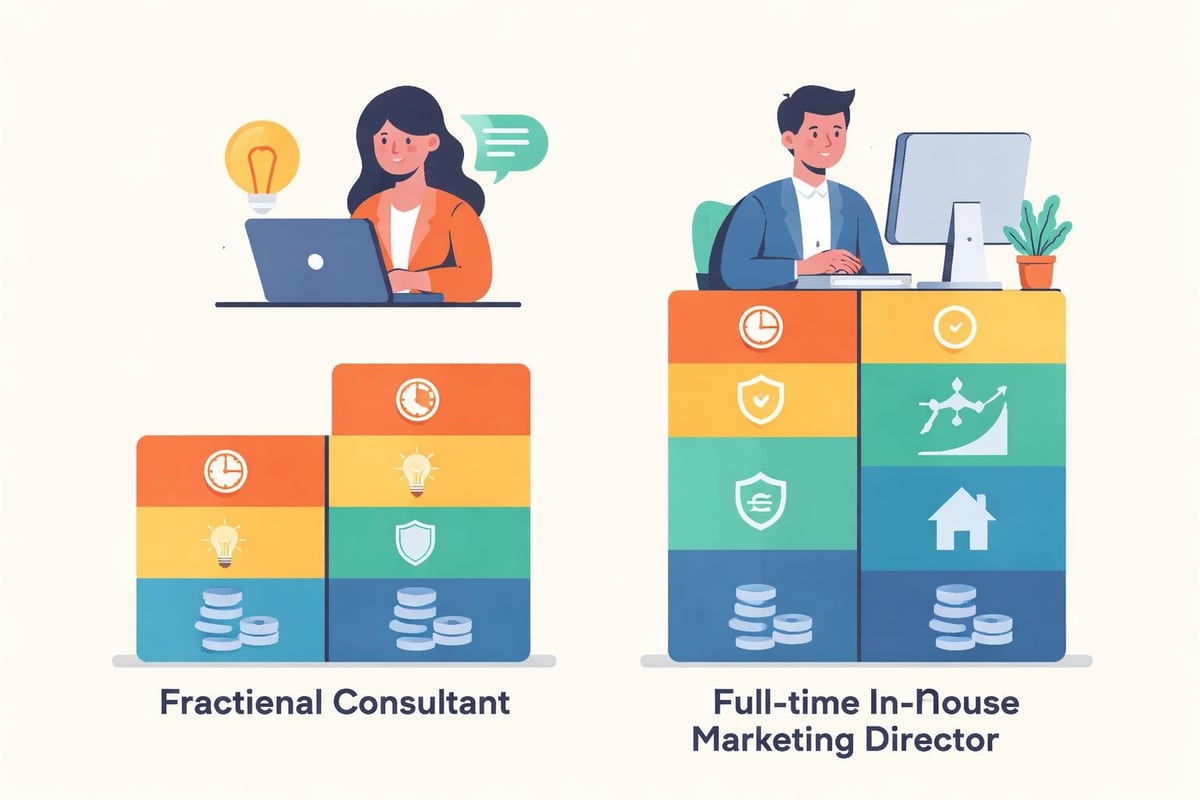
When evaluating fractional marketing services against in-house hiring, most founders fixate on salary figures. That’s a mistake. The true cost calculation extends far beyond base compensation.
Ready to take the next step?
Book a Free CallA full-time marketing director in a major tech hub commands $150,000 to $200,000 annually, plus benefits, equity, onboarding time, and management overhead. Add another 20-30% for payroll taxes, health insurance, and workspace costs. You’re looking at $195,000 to $260,000 for a single hire who may need three to six months to reach full productivity.
Fractional marketing consultant costs typically include:
- Strategic planning and execution (15-20 hours weekly)
- Immediate access to senior-level expertise
- No benefits, equity dilution, or employment overhead
- Flexibility to scale hours up or down monthly
- Built-in replacement if the consultant becomes unavailable
A part time marketing team through fractional services usually runs $6,000 to $15,000 monthly depending on scope and seniority. That’s $72,000 to $180,000 annually with zero ramp time and the ability to adjust or discontinue services with 30 days’ notice.
The Hidden Costs of In-House Teams
Budget-conscious founders often overlook the indirect expenses that accompany full-time hires. Recruitment fees typically consume 20-25% of first-year salary. Executive search firms charge even more for senior marketing roles.
Then comes the technology stack. Marketing automation platforms, analytics tools, content management systems, and design software add $1,000 to $3,000 monthly. A fractional marketing team usually brings their own tool licenses, saving you immediate capital outlay.
Management time represents another hidden cost. Early-stage CEOs spend 10-15 hours weekly managing their first marketing hire, handling performance reviews, strategic alignment, and cross-functional coordination. That’s bandwidth diverted from product development, fundraising, and customer acquisition.
Seed Stage: Why Fractional Usually Wins
Pre-seed and seed-stage companies face unique constraints that make fractional marketing services the logical choice. You’re validating product-market fit, refining messaging, and establishing initial distribution channels. You need strategic guidance and hands-on execution, but you cannot afford mistakes or long hiring cycles.
According to Entrepreneur magazine, fractional CMOs help businesses scale their marketing efforts efficiently by bringing proven frameworks and avoiding common pitfalls that burn runway.
| Seed Stage Priority | Fractional Advantage | In-House Challenge |
|---|---|---|
| Message validation | Tests multiple approaches quickly | Single perspective, slower iteration |
| Channel testing | Experience across channels | Limited to one person’s expertise |
| Budget efficiency | Pay for results, not ramp time | Fixed cost regardless of output |
| Founder education | Teaches you what to look for in future hires | No knowledge transfer mechanism |
Your seed-stage fractional marketing consultant should deliver:
- Market positioning and messaging framework
- Foundational content marketing strategy
- Initial SEO infrastructure and keyword targeting
- Demand generation experiments across 2-3 channels
- Analytics setup and performance dashboards
- Documentation of what works for future team members
At GrowthExpertz, we focus on building repeatable systems during the seed stage that become the foundation for future growth consulting engagements as companies scale.
The typical seed-stage engagement runs six to twelve months. By the end, you should have validated messaging, proven acquisition channels, and documented processes that a future in-house hire can execute and scale.
Series A: The Hybrid Approach
Series A represents a transitional stage where the optimal model often combines fractional leadership with specialized in-house execution. You’ve proven product-market fit and need to scale what’s working, but you’re not ready for a full marketing department.
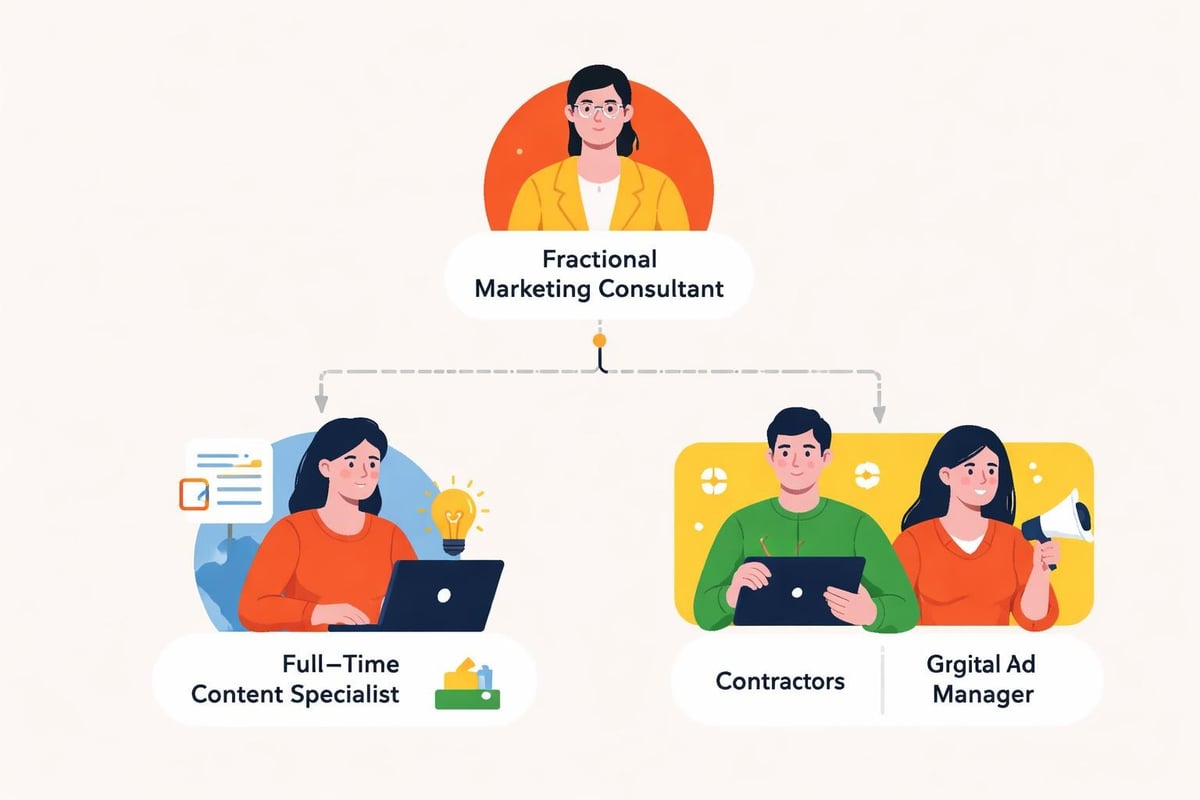
This is where a fractional marketing consultant provides strategic oversight while you hire tactical specialists. Think of it as having a VP of Marketing three days a week who manages your full-time content marketer and contractor-based designers.
Building Your First Hybrid Team
Start with fractional leadership, then add in-house capacity based on your highest-volume needs. For most B2B SaaS companies, that means hiring a content marketer or demand generation specialist as your first full-time role.
Effective Series A hybrid model:
- Fractional CMO or marketing director (15-20 hours weekly)
- Full-time content marketer or demand gen specialist
- Contractor-based design and development resources
- Agency partnership for specialized needs (SEO technical implementation, paid media management)
This structure gives you senior strategic thinking without the $200,000+ salary commitment. Your fractional leader mentors the full-time hire, ensures strategic alignment, and brings expertise your junior team member lacks.
Ready to take the next step?
Book a Free CallCMO Australia explains how fractional CMOs fill leadership gaps while companies build their internal capabilities, making them ideal for this transitional phase.
The financial math works too. A $120,000 content marketer plus $10,000 monthly for fractional leadership totals approximately $240,000 annually. That’s less than hiring a VP of Marketing, and you get both strategic oversight and dedicated execution capacity.
When to Keep the Fractional Model at Series A
Not every Series A company should immediately hire in-house. Consider maintaining a fully fractional approach if you’re:
- Still testing multiple go-to-market strategies
- Operating in a highly specialized niche requiring rare expertise
- Prioritizing product development over marketing expansion
- Planning aggressive Series B fundraising within 12-18 months
- Experiencing high market uncertainty or pivot potential
Outsourced marketing services provide flexibility when your strategic direction might shift. A part time marketing team adapts faster than restructuring full-time employees.
Many of our clients at GrowthExpertz maintain fractional relationships through Series B, gradually transitioning to full-time teams only when their acquisition systems are proven and scalable.
Series B: Building Toward Full In-House
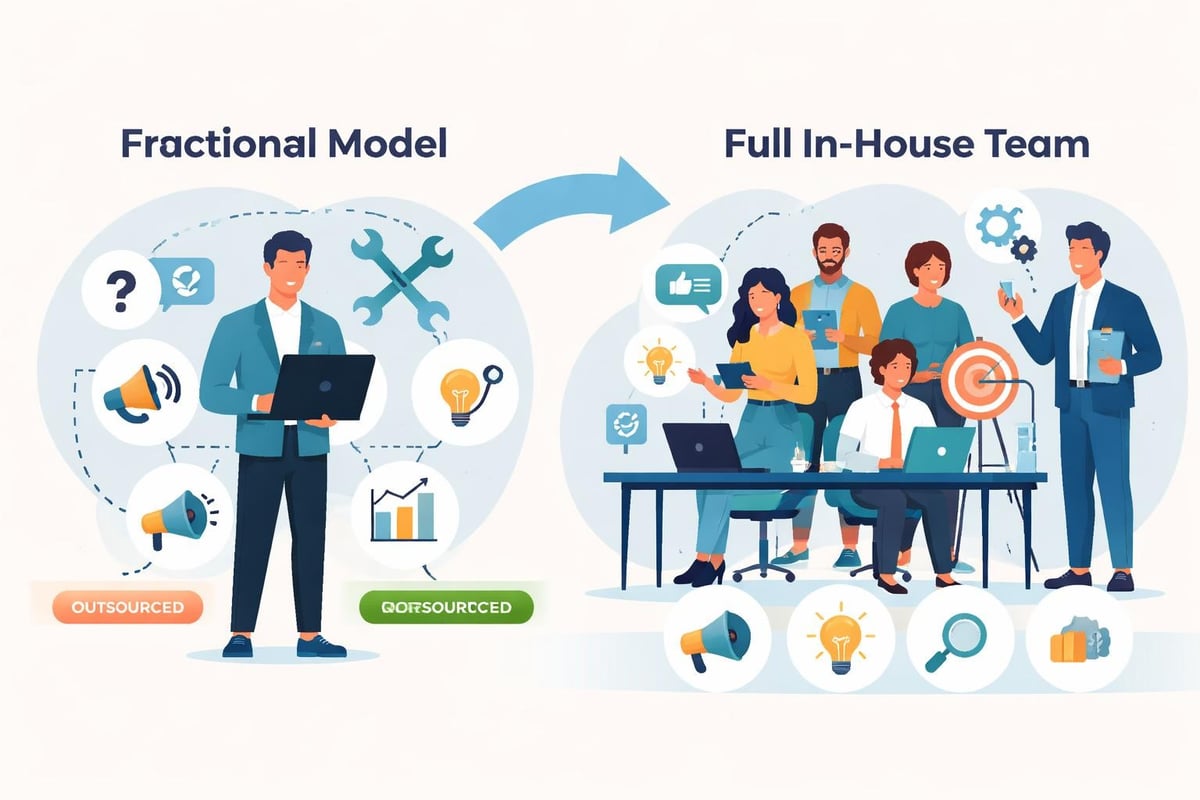
Series B marks the inflection point where most companies transition from predominantly fractional to majority in-house teams. You have proven unit economics, established brand presence, and need dedicated resources to execute at scale.
But here’s the critical insight: your fractional foundation determines in-house success. Companies that build documented systems, proven playbooks, and measurable processes during their fractional phase hire better and scale faster.
The Staged Transition Strategy
Rather than abruptly replacing your fractional marketing consultant with a full-time CMO, execute a phased transition that preserves institutional knowledge and reduces risk.
Month 1-3: Preparation Phase
Your fractional team documents everything. Every process, every campaign structure, every analytics dashboard, every vendor relationship gets captured in written playbooks. This becomes your hiring blueprint and onboarding foundation.
Month 4-6: Hiring Phase
Your fractional leader helps define the role, screens candidates, and participates in final interviews. They know what skills you need because they’ve been doing the work. This dramatically improves hiring quality.
Month 7-9: Transition Phase
The new full-time CMO overlaps with your fractional consultant for 60-90 days. They learn your systems, understand your metrics, and inherit proven processes rather than starting from scratch.
Month 10-12: Advisory Phase
Your former fractional consultant shifts to an advisory capacity, available for strategic questions and specialized projects but no longer handling day-to-day execution.
| Transition Approach | Success Rate | Time to Full Productivity | Common Challenges |
|---|---|---|---|
| Abrupt replacement | 40-50% | 6-9 months | Knowledge loss, strategic gaps |
| 30-day handoff | 60-70% | 4-6 months | Incomplete transfer, relationship gaps |
| 90-day overlap | 85-90% | 2-3 months | Higher short-term cost |
Building Your Series B Marketing Department
By Series B, your marketing org should include specialized full-time roles supported by fractional expertise in areas requiring senior-level strategic thinking.
A typical Series B marketing team includes:
- VP of Marketing or CMO (full-time)
- Demand generation manager (full-time)
- Content marketing manager (full-time)
- Product marketing manager (full-time)
- Marketing operations specialist (full-time)
- SEO and content execution (mix of in-house and agency)
- Paid media management (often outsourced to specialists)
- Design and creative (contractors or small in-house team)
Notice that specialized functions like SEO agency work and paid media often remain outsourced even at Series B. These disciplines require depth that’s difficult to justify in a single full-time hire.
The Functions That Stay Fractional Even After In-House Hiring
Experienced growth leaders recognize that certain marketing functions deliver better ROI when kept fractional regardless of company stage. These typically require either highly specialized expertise or variable capacity needs that don’t justify full-time headcount.
Specialized technical execution like enterprise SEO, conversion rate optimization, and marketing automation architecture often performs better through outsourced marketing services. The expertise required commands $150,000+ salaries, but most companies need only 10-15 hours weekly of that caliber work.
Strategic advisory functions including market research, competitive intelligence, pricing strategy, and GTM planning benefit from external perspective. Even companies with strong in-house teams engage fractional strategists for quarterly planning and major initiatives.
Overflow capacity for content production, design, and campaign execution makes more sense through a part time marketing team. Hiring full-time for peak capacity means underutilization during slower periods.
Understanding which fractional marketing services to maintain post-hiring prevents the common mistake of bringing everything in-house prematurely. Our fractional marketing approach emphasizes building hybrid models that optimize for both cost and capability.
Making the Decision: Your Stage-Based Framework
Every funding stage demands different marketing capabilities, making the fractional versus in-house decision highly contextual. Use this framework to evaluate your optimal model.
Pre-Seed and Seed Stage Decision Criteria
Choose fractional if you:
- Have less than $2M in funding
- Are still validating messaging and positioning
- Need to test multiple acquisition channels quickly
- Want strategic guidance plus hands-on execution
- Cannot afford hiring mistakes or long ramp times
Consider in-house if you:
- Have a founder with deep marketing expertise who can lead effectively
- Operate in a highly specialized industry where fractional expertise is unavailable
- Have already proven acquisition channels and need pure execution capacity
Series A Decision Criteria
Choose hybrid fractional/in-house if you:
- Have proven 2-3 acquisition channels that need scaling
- Can afford one full-time specialist plus fractional leadership
- Need strategic oversight but lack budget for senior full-time hire
- Want to train junior talent under experienced guidance
Choose fully fractional if you:
- Are still testing go-to-market approaches
- Operate in complex enterprise sales with long cycles
- Prioritize product development and plan to scale marketing post-Series B
Series B Decision Criteria
Begin in-house transition if you:
- Have documented, repeatable acquisition systems
- Generate predictable pipeline from established channels
- Need dedicated resources for brand building and market expansion
- Can support 4+ marketing team members
Maintain fractional elements if you:
- Require specialized expertise (technical SEO, marketing ops, data science)
- Need variable capacity for content and creative production
- Value external perspective for strategic planning
- Want advisory support without full-time management burden
Building Systems That Transfer Successfully
The single biggest determinant of successful fractional-to-in-house transition is documentation quality. Companies that build strong operational systems during their fractional phase experience 3-4x faster onboarding when hiring full-time teams.
Your fractional marketing consultant should create:
Campaign playbooks documenting proven approaches for each acquisition channel, including targeting criteria, creative frameworks, budget allocation, and success metrics. Future team members replicate what works rather than experimenting blindly.
Process documentation covering content workflows, approval chains, vendor management, and cross-functional collaboration. This prevents the “single point of failure” problem where only one person knows how things work.
Performance dashboards with clearly defined metrics, tracking mechanisms, and reporting cadences. New hires understand what success looks like and how to measure progress.
Vendor and tool inventories listing every platform, login credential, contract term, and relationship contact. Transitions fail when access and institutional knowledge walk out the door.
At GrowthExpertz, our marketing process specifically emphasizes building transferable systems that support eventual in-house teams. We measure success not just by marketing performance but by how effectively we enable future hiring.
The Financial Breakeven Analysis
Understanding when in-house hiring becomes financially advantageous requires comparing total costs over 24-36 month horizons, not just annual figures.
Year one economics typically favor fractional services. A senior fractional marketing consultant costs $120,000 to $180,000 annually with immediate productivity. A full-time VP of Marketing costs $240,000+ with 3-6 months ramp time, meaning effective first-year cost approaches $300,000+ when accounting for reduced productivity.
Year two shifts the equation for companies with stable, proven strategies. The full-time hire reaches peak productivity while fractional costs remain constant. If you need 30+ hours weekly of senior marketing talent executing the same playbook repeatedly, in-house becomes more cost-effective.
Year three advantages compound for in-house teams that successfully scale. A VP of Marketing who hires and manages junior team members provides leverage impossible with fractional models. They build organizational capability that appreciates over time.
However, this analysis assumes hiring success. Failed hires (25-35% of marketing executives don’t survive 18 months) reset the clock and waste 12-18 months of runway. Fractional models eliminate this risk through month-to-month flexibility.
Common Mistakes That Destroy Value
Both fractional and in-house approaches fail when executed poorly. Avoid these common errors that undermine marketing investment regardless of team structure.
Treating fractional consultants like employees creates friction and reduces effectiveness. A part time marketing team operates differently than direct reports. They own outcomes, not tasks. Micromanaging fractional resources wastes their strategic value.
Hiring in-house too early before validating acquisition channels burns capital and creates organizational debt. Teams need direction. Without proven strategies to execute, even talented marketers struggle to deliver ROI.
Waiting too long to transition from fractional to in-house limits scaling velocity. Once you have documented systems and proven unit economics, fractional capacity constraints prevent optimal growth.
Eliminating fractional relationships completely after hiring in-house removes valuable external perspective. The most sophisticated marketing organizations maintain fractional advisory relationships even with strong internal teams.
Choosing based solely on cost rather than strategic fit leads to misaligned expectations. The cheapest option rarely delivers the best outcomes. Evaluate based on expertise, cultural fit, and stage-appropriate capabilities.
The GrowthExpertz Approach to Fractional Foundations
Our philosophy centers on building marketing infrastructure that supports your eventual in-house team rather than creating dependency. When you work with fractional marketing services from GrowthExpertz, we’re explicitly preparing you for successful hiring.
We document every process, explain every strategic decision, and transfer knowledge continuously. Our content marketing and demand generation work creates playbooks your future team executes and improves.
This approach means some clients graduate from our services faster than they might otherwise. That’s intentional. We measure success by your growth trajectory, not how long you remain dependent on fractional support.
For companies exploring the benefits of fractional leadership across multiple functions, we often coordinate with fractional CFOs, CTOs, and operational leaders to ensure strategic alignment without the overhead of full C-suite hiring.
The fractional versus in-house decision should evolve with your startup’s maturity, following your funding stage, strategic clarity, and execution capacity. Starting with a fractional marketing consultant at seed stage lets you validate channels and build systems before committing to full-time headcount, while hybrid models at Series A balance strategic leadership with dedicated execution, and thoughtful transitions at Series B preserve institutional knowledge as you scale. GrowthExpertz specializes in building these fractional foundations that set your eventual in-house team up for immediate success, creating documented playbooks and proven acquisition systems rather than dependencies. If you’re evaluating marketing options for your current stage, explore how GrowthExpertz can help you build the right foundation today while preparing for tomorrow’s growth.

Andrew Lee Miller is a veteran startup marketer, growth hacker, and founder of GrowthExpertz with more than 20 years of experience helping startups scale. Known online as “AndrewStartups,” he has helped drive multiple VC-backed startup exits, advised dozens of funded SaaS companies, and built growth systems for early-stage startups across industries. Since founding GrowthExpertz in 2016, Andrew has focused on lean, AI-powered startup marketing strategies spanning SEO, content, paid ads, PR, outbound, and growth experimentation. He’s also a global keynote speaker, published author, and startup growth coach who has lectured in more than 15 countries on startup marketing and growth hacking.


