

Early-stage startups face a critical dilemma: you need executive-level marketing leadership to scale, but a full-time CMO commands $200,000 to $300,000 in annual compensation plus equity, which can consume six to twelve months of runway. That’s capital that could fuel product development, customer acquisition, or team expansion. Enter the fractional CMO for startups, a strategic solution that GrowthExpertz uses to deliver C-suite marketing expertise without the full-time executive burden. This model provides funded B2B and SaaS companies with the strategic thinking, market positioning, and growth frameworks they need, while preserving capital for the initiatives that directly impact revenue.
Understanding the Fractional CMO Model for Startups
A startup fractional CMO operates as a part-time executive who brings senior-level marketing strategy and leadership to growth-stage companies on a flexible engagement basis. Unlike consultants who deliver recommendations and exit, fractional CMOs embed themselves in your business, owning marketing outcomes and building scalable systems.
Ready to take the next step?
Book a Free CallThe engagement typically involves 15-30 hours per week, focused on high-impact strategic work rather than tactical execution. This structure allows startups to access the same caliber of leadership available to enterprise organizations, but at a fraction of the investment.
What Distinguishes a Fractional CMO from Other Marketing Resources
The differences between various marketing roles matter when you’re allocating limited resources:
| Role Type | Strategic Focus | Execution Capability | Typical Investment | Best For |
|---|---|---|---|---|
| Fractional CMO | High | Moderate (through team) | $5K-$15K/month | Strategic planning, team leadership, growth frameworks |
| Marketing Consultant | Moderate | Low | $150-$400/hour | Specific projects, audits, recommendations |
| Marketing Manager | Low-Moderate | High | $80K-$120K/year | Day-to-day execution, campaign management |
| Full-Time CMO | High | High (through team) | $200K-$300K+/year | Established companies with proven product-market fit |
A fractional CMO for startups sits at the intersection of strategic vision and practical implementation. They don’t just advise; they build your marketing function from the ground up, establishing processes, hiring talent, and creating repeatable acquisition systems that survive beyond their engagement.
The Capital Efficiency Case for Part-Time CMO Leadership
Runway optimization separates successful startups from those that burn through capital before achieving product-market fit. Every dollar allocated to overhead represents a dollar unavailable for customer acquisition, product development, or market expansion.
Consider the mathematics: a full-time CMO at $250,000 annually (including benefits and equity) costs approximately $20,800 per month. A fractional CMO engagement costs between $5,000 and $15,000 monthly, delivering 60-75% of that executive’s strategic value at 20-40% of the cost.
Where the Savings Compound
The financial advantages extend beyond salary differentials:
- No equity dilution: Fractional arrangements typically operate on fee-for-service models, preserving founder ownership
- Reduced benefits overhead: Health insurance, 401(k) matching, and other benefits add 20-30% to full-time compensation
- Faster deployment: No lengthy executive searches or onboarding periods
- Flexible scaling: Adjust engagement levels based on funding stage and growth velocity
For a Series A startup with $3 million in funding and an 18-month runway, choosing a fractional approach could extend that runway by 3-4 months, providing critical breathing room to hit the next milestone.
Strategic Capabilities That Drive Measurable Growth
The value proposition of an outsourced CMO centers on their ability to implement growth frameworks that transform marketing from an expense into a revenue driver. These executives bring pattern recognition from working across multiple startups, understanding what works in different market conditions.
Building Your Go-To-Market Foundation
Strategic planning for startups requires clarity on positioning, messaging, and market approach. A fractional CMO establishes these foundations through systematic analysis:
- Market segmentation and ICP definition: Identifying your most valuable customer segments based on conversion data, lifetime value, and acquisition cost
- Competitive positioning: Establishing differentiation that resonates with your target market’s actual pain points
- Messaging architecture: Creating a hierarchy of value propositions that speak to different buyer personas and funnel stages
- Channel strategy: Allocating resources across acquisition channels based on CAC, conversion rates, and scalability
This strategic groundwork prevents the scattered approach many startups take, where marketing efforts span too many channels with insufficient depth in any single area.
Demand Generation Systems That Scale
Revenue-focused fractional CMOs build acquisition systems, not just campaigns. They understand that growth for B2B and SaaS startups requires repeatable processes that consistently generate qualified pipeline.
The system components include:
- Content strategy aligned with buyer journey stages: Mapping content assets to awareness, consideration, and decision phases
- SEO foundations that compound over time: Technical optimization, content creation, and authority building that continues generating traffic months after publication
- Paid acquisition frameworks: Testing protocols, creative rotation systems, and conversion optimization processes
- Lead scoring and qualification: Defining MQL and SQL criteria that align marketing and sales on prospect quality
When Startups Benefit Most from Fractional CMO Expertise
Timing matters significantly when introducing executive marketing leadership. Engage too early, and you’re paying for strategic thinking before you have product-market fit. Wait too long, and you’ve squandered growth opportunities with unfocused marketing efforts.
Optimal Engagement Windows
The most successful fractional CMO engagements occur during specific inflection points:
Ready to take the next step?
Book a Free CallPost-Seed/Pre-Series A: You’ve validated initial product-market fit with 10-20 paying customers and need to formalize your go-to-market approach before scaling acquisition. This stage requires strategic guidance to transition from founder-led sales to a repeatable marketing engine.
Post-Series A: Fresh capital enables growth investment, but you need strategic direction to allocate resources effectively across channels, build a marketing team, and establish measurement frameworks that demonstrate ROI to investors.
Pre-Series B: Growth has plateaued or customer acquisition costs have risen beyond sustainable levels. You need senior expertise to diagnose issues, optimize existing channels, and identify new growth levers.
Marketing Team Transition: Your founding marketing hire has hit their ceiling or departed, and you need interim leadership while recruiting a permanent replacement.
Red Flags That Signal the Need for Strategic Leadership
Certain symptoms indicate your startup would benefit from fractional CMO intervention:
- Marketing generates activity but not pipeline: High social media engagement or website traffic that doesn’t convert to qualified leads
- No clear attribution or measurement: Inability to answer which channels drive the best customers or what marketing’s actual ROI is
- Reactive rather than strategic execution: Marketing team constantly responding to requests without an overarching strategy
- Sales and marketing misalignment: Disagreement on lead quality, target personas, or messaging approach
- Investor pressure for growth metrics: Board members asking for marketing efficiency metrics you can’t provide
Structuring an Effective Fractional CMO Engagement
The engagement model determines whether you extract maximum value or create another vendor relationship that underdelivers. Successful partnerships require clear scope definition, outcome alignment, and integration with existing teams.
Defining Scope and Deliverables
Precision in role definition prevents scope creep and misaligned expectations. Your engagement should specify:
| Element | Specification | Example |
|---|---|---|
| Time Commitment | Hours per week or month | 20 hours/week (half-time equivalent) |
| Primary Objectives | 2-3 measurable outcomes | Reduce CAC by 30%, build demand gen framework, hire marketing manager |
| Decision Authority | Areas where CMO has final say | Channel budget allocation, messaging, vendor selection |
| Team Interaction | Reporting structure and collaboration model | Weekly executive team meetings, daily Slack access, monthly board reporting |
| Duration | Initial term and renewal criteria | 6-month initial term, renewable based on KPI achievement |
Fractional marketing leadership works best when integrated into your executive team, participating in strategic discussions beyond marketing scope. This broader context enables better alignment between marketing initiatives and business objectives.
Success Metrics That Matter
Avoid vanity metrics in favor of indicators that directly correlate with business outcomes. Track performance through:
- Pipeline contribution: Marketing-generated opportunities as percentage of total pipeline
- Customer acquisition cost (CAC): Total marketing spend divided by new customers acquired
- CAC payback period: Months required to recover acquisition cost through customer revenue
- Marketing qualified lead (MQL) volume and conversion rate: Leading indicators of pipeline health
- Content performance metrics: Organic traffic growth, keyword rankings, backlink acquisition for SEO initiatives
Establish baseline measurements during month one, set quarterly targets, and review progress in monthly business reviews. This data-driven approach ensures accountability while providing early warning signs if strategy adjustments are needed.
Integrating Fractional Leadership with Your Existing Team
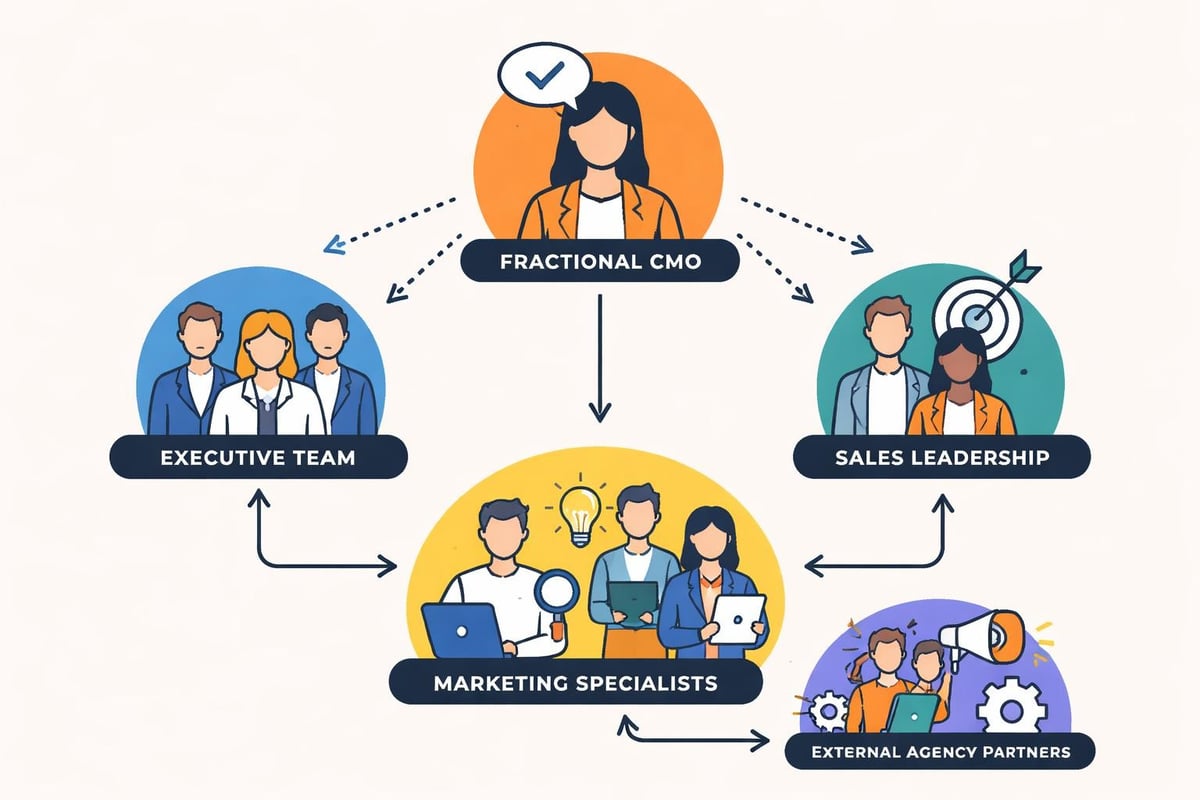
The most effective fractional CMOs amplify your team rather than replace them. They provide the strategic direction that allows execution-focused team members to work more effectively while identifying capability gaps that require additional hiring or specialized support in areas like SEO or content marketing.
Building Productive Working Relationships
Integration success depends on clear communication and role clarity:
For marketing team members: The fractional CMO becomes their strategic leader, providing direction, coaching, and career development while respecting their existing expertise. They should conduct individual meetings with each team member, understand their strengths and growth areas, and create development plans that align with company needs.
For founding teams: Technical founders and first-time CEOs benefit significantly from fractional CMO guidance on go-to-market strategy, particularly when lacking marketing background. The relationship works best when founders trust the CMO’s expertise while providing context on product, customers, and company vision.
For sales leadership: Alignment between marketing and sales determines whether leads convert to revenue. The fractional CMO should establish service level agreements (SLAs) with sales on lead quality, follow-up timelines, and feedback loops that continuously improve targeting.
Avoiding Common Integration Pitfalls
Several patterns predict fractional engagement failure:
- Treating the CMO as a consultant rather than a leader with decision authority
- Failing to provide access to necessary data, tools, or team members
- Expecting tactical execution on par with a full marketing department
- Neglecting to communicate the CMO’s authority to the broader team
- Withholding information about business challenges, funding runway, or strategic pivots
Comparing Investment Models: Fractional vs. Full-Time vs. Agency
Resource allocation represents one of the most consequential decisions for startup marketing. Each model offers distinct advantages depending on your stage, budget, and immediate needs.
The Three-Model Comparison
Fractional CMO: Best for startups needing strategic leadership and framework building without full-time executive overhead. Ideal from post-seed through Series B when you need senior guidance but lack the budget or workload for a full-time executive. This model provides marketing advice and strategic guidance while preserving capital for growth investments.
Full-Time CMO: Appropriate for later-stage startups (Series B+) with proven product-market fit, substantial marketing budgets ($100K+ monthly), and the need for constant executive presence across multiple time zones or markets. The complexity and scale justify dedicated leadership.
Marketing Agency: Suitable for execution-heavy needs like content production, paid advertising management, or SEO implementation. Agencies deliver tactical excellence but rarely provide strategic leadership or long-term framework building. Many fractional CMOs work alongside agencies, providing strategy while agencies handle execution.
Hybrid Models That Maximize Efficiency
The most capital-efficient approach often combines fractional leadership with specialized execution partners:
- Fractional CMO for strategy, team building, and growth framework development
- Content marketing agency for article production, asset creation, and editorial management
- SEO specialist for technical optimization and link building
- In-house coordinator for project management and daily coordination
This model provides 100% of strategic thinking for 20% of executive cost while maintaining execution velocity through specialized partners who excel in their domains.
Selecting the Right Fractional CMO for Your Startup
Not all fractional CMOs bring equal value to startups. The ideal candidate combines startup experience, vertical expertise, and tactical capabilities aligned with your growth stage and market.
Essential Qualifications and Experience
Prioritize candidates who demonstrate:
- Startup-specific experience: Understanding of constrained resources, rapid iteration, and the unique challenges of building marketing functions from scratch
- Vertical relevance: B2B SaaS requires different approaches than consumer products or professional services
- Stage alignment: Early-stage startups need different skills than scaling companies approaching Series C
- Hands-on capability: Willingness to build frameworks themselves rather than only delegating
- Data orientation: Comfort with analytics, attribution modeling, and performance optimization
Request case studies showing measurable outcomes at companies similar to yours in stage, industry, and business model. Avoid candidates whose experience centers exclusively on large enterprises or dramatically different markets.
The Vetting Process
Structure your evaluation through multiple interaction points:
| Stage | Focus | Key Questions |
|---|---|---|
| Initial Conversation | Background and approach | How do you typically structure engagements? What’s your experience in [your vertical]? |
| Strategy Discussion | Problem-solving capability | Given our situation, what would your first 90 days look like? What metrics would you track? |
| Reference Checks | Execution and relationship quality | How did they handle challenges? What were the measurable outcomes? Would you hire them again? |
| Trial Project | Working style compatibility | Complete a small scoped project before full engagement |
Pay attention to how candidates approach your specific challenges. Generic advice suggests limited expertise, while customized recommendations based on your market, competition, and current metrics indicate genuine strategic thinking.
Maximizing ROI from Your Fractional CMO Investment
The return on fractional leadership depends heavily on how effectively you leverage their time and expertise. Strategic preparation and ongoing optimization ensure you extract maximum value.
Pre-Engagement Preparation
Before your fractional CMO starts, assemble the resources they’ll need for rapid impact:
- Access to all marketing tools, analytics platforms, and CRM systems
- Historical performance data covering at least the past six months
- Customer research including personas, interview notes, and survey results
- Competitive intelligence on positioning, pricing, and messaging
- Financial targets including CAC goals, pipeline requirements, and revenue targets
This preparation allows your CMO to assess current state immediately rather than spending billable hours gathering basic information.
Structuring the First 90 Days
The initial quarter establishes the foundation for everything that follows. Effective fractional CMOs approach startup growth through phased implementation:
Days 1-30: Assessment and Strategy
- Audit current marketing efforts, identify what’s working and what isn’t
- Interview team members, customers, and key stakeholders
- Analyze competitive landscape and market positioning
- Define 6-month strategic roadmap with measurable milestones
Days 31-60: Framework Building
- Establish measurement systems and reporting dashboards
- Implement core processes for campaign planning, content creation, and lead management
- Begin hiring or agency vetting for critical capability gaps
- Launch 2-3 quick-win initiatives that demonstrate momentum
Days 61-90: Optimization and Scaling
- Analyze early results and adjust tactics based on performance data
- Solidify team structure and role definitions
- Establish recurring meetings, reporting cadence, and communication protocols
- Transition from setup to ongoing optimization mode
Long-Term Value Creation Beyond the Engagement
The most valuable fractional CMOs build systems that outlive their tenure. Rather than creating dependencies, they establish frameworks, develop team capabilities, and document processes that enable continued success after they transition out.
Building Institutional Knowledge
Document everything to preserve strategic context:
- Marketing strategy decks that explain positioning, messaging, and channel rationale
- Playbooks for recurring activities like campaign launches, content production, or event execution
- SOPs for tools, reporting, and cross-functional workflows
- Performance benchmarks that establish normal ranges for key metrics
This documentation enables seamless transitions whether moving to a full-time CMO, promoting an internal candidate, or shifting to a different fractional leader.
Developing Your Marketing Team
Strong fractional CMOs focus on capability building, not dependency creation. They should:
- Coach team members on strategic thinking, not just task execution
- Create career development plans aligned with company growth
- Identify high-potential team members who could grow into leadership roles
- Establish feedback loops that continuously improve team performance
The measure of fractional CMO success isn’t how indispensable they become but how effectively they build a marketing function that thrives independently. Your team should emerge from the engagement more capable, confident, and strategically oriented than when they started.
For funded startups navigating the balance between growth acceleration and capital preservation, fractional marketing leadership offers executive-level strategy without the full-time commitment that strains runway. The right engagement delivers measurable improvements in pipeline quality, customer acquisition efficiency, and marketing team capability while maintaining the financial flexibility growth-stage companies require. GrowthExpertz helps B2B and SaaS startups build these scalable acquisition systems through fractional marketing leadership paired with specialized execution across SEO, content, and demand generation, turning constrained budgets into repeatable growth engines.

Andrew Lee Miller is a veteran startup marketer, growth hacker, and founder of GrowthExpertz with more than 20 years of experience helping startups scale. Known online as “AndrewStartups,” he has helped drive multiple VC-backed startup exits, advised dozens of funded SaaS companies, and built growth systems for early-stage startups across industries. Since founding GrowthExpertz in 2016, Andrew has focused on lean, AI-powered startup marketing strategies spanning SEO, content, paid ads, PR, outbound, and growth experimentation. He’s also a global keynote speaker, published author, and startup growth coach who has lectured in more than 15 countries on startup marketing and growth hacking.


